
H7 vs H11 Headlight Bulbs: Key Differences Explained
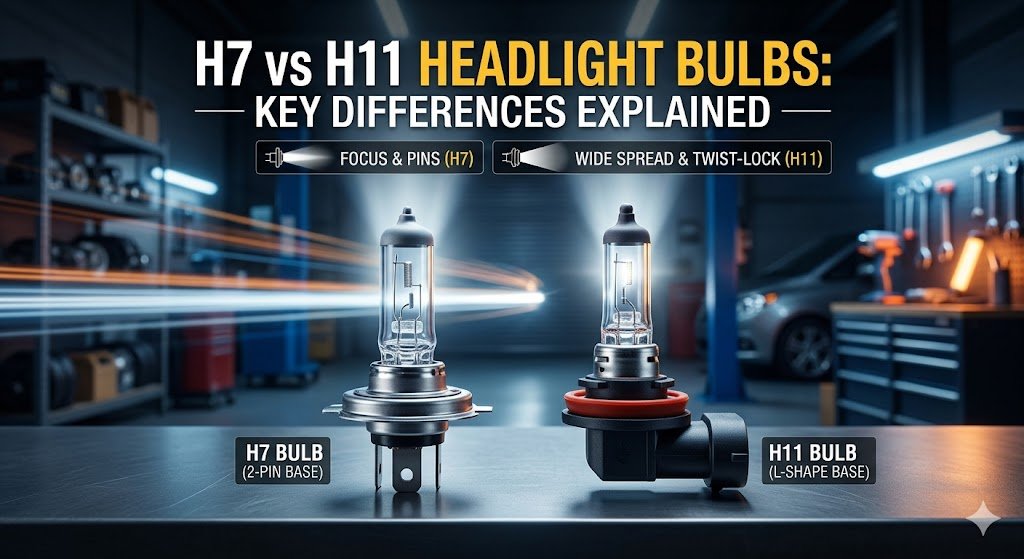
When it comes to upgrading or replacing your car’s headlights, diving into the world of bulb sizes can feel like alphabet soup. Two of the most popular halogen and LED upgrade sizes on the market today are H7 and H11.
At first glance, they might look similar, but putting the wrong bulb into your vehicle’s assembly simply won’t work. Let’s break down the key differences between H7 and H11 bulbs so you can make the right choice for your ride.
1. The Design and Base Type (The Biggest Difference)
The absolute most critical distinction between these two bulbs is their physical design. You cannot swap an H7 into an H11 socket (or vice versa) because their bases are entirely different.
H7 Bulbs: These feature a two-pin base configuration. They are straight, prong-like connectors that slide directly into the vehicle’s wiring harness adapter. They rely on a separate metal clip or twist-lock retainer within the headlight assembly to stay secure.
H11 Bulbs: These utilize an L-shaped design with a plastic right-angle connector base. They feature a built-in pre-aligned plastic flange with tabs that allow you to insert the bulb into the housing and twist it to lock it into place. They also include a rubber O-ring seal to keep moisture out of the headlight assembly.
2. Voltage and Wattage
While both bulbs operate on standard 12-volt automotive electrical systems, their standard power consumption differs slightly:
| Feature | H7 Bulb | H11 Bulb |
| Standard Wattage | 55 Watts | 55 Watts (Standard) / 65 Watts (H9 equivalent upgrades) |
| Common Application | Low beam or High beam (Separate housing) | Primarily Low beam or Fog lights |
While both pull 55W at stock levels, the internal filament design differs, affecting how they project light through your car’s optics.
3. Light Output and Beam Pattern
Because of how they are manufactured, they serve different optical purposes:
H7: Often used in European vehicles and dual-beam setups (where one H7 handles the low beam and another handles the high beam). It provides a sharp, focused beam pattern.
H11: Extremely common in modern low-beam projector and reflector headlights, as well as fog lights. It is designed to provide a wider spread of light to illuminate the sides of the road and the immediate foreground.
4. Lifespan and Thermal Efficiency
Generally, H11 bulbs tend to have a slightly longer lifespan than standard H7 halogens.
Because H7 bulbs are more compact, they can trap heat closer to the filament, causing them to burn out a bit quicker under heavy night-driving conditions. The L-shaped base of the H11 acts slightly better as a heat sink, giving it a minor edge in durability.
Summary: Can You Intermix Them?
The Short Answer: No.
You cannot use an H7 bulb in an H11 socket. Even if you were to modify the wiring, the bulb will not physically fit into the headlight lens opening, and it will not lock into place to create a weatherproof seal. Always check your vehicle’s owner’s manual or look at the engraved text on your old bulb before purchasing a replacement.
Upgrading to LED?
If you are planning to upgrade from halogen to LED for brighter night vision, the same rules apply. You will need to buy the exact fitment (H7 LED kit or H11 LED kit) that matches your car’s factory specifications. Modern LED upgrades mimic the exact filament location of these bulbs to ensure you don’t blind oncoming traffic while enjoying much better visibility.